There is a particular silence in a queue where nobody wants to make eye contact.
In 2018, Bangalore. I am standing at a water ATM with a can in my hand. Around me: software engineers. You can tell. The lanyards, the backpacks, the half-charged phones. These are people who spend their days building systems that move money across continents in milliseconds, and this evening they are standing in the dark, waiting their turn for twenty litres of drinking water.
Bangalore was not out of water.
That is the part I could not get past. The city had water. It had rain, it had lakes, it had aquifers. It had tankers sitting full and idle in one part of town while another part paid whatever was asked. What the city did not have was any reliable way to move water from where it existed to where it was needed, fast enough, with anyone trusting anyone else along the way.
I was not angry in that line. I was in shock. A dumb, disbelieving shock that in 2018, in a city running a meaningful share of the world's software, we had not solved the problem of getting water to people standing right there asking for it.
I have spent every year since circling that one thing. Not water. The gap.
Oracle wanted the same brand every time
The shock started a few months earlier, and it started as a procurement problem.
I was running sales at a startup that supplied offices. Thousands of SKUs. Pens, printers, pantry, cleaning, all of it. We had just closed a pan-India deal to supply Oracle with bottled drinking water across their offices. Water. After everything else we had delivered, this felt like the easy part of the contract.
It was the hardest thing we ever did.
Oracle's requirements were not unreasonable. They wanted the exact same brand in every office in every city. They wanted a lab test report with every batch. Any large employer with a duty of care would want those things. But those two requirements, in India, in 2018, collided with reality in a way I did not anticipate: brand availability was regional, certified testing was concentrated in a handful of places, and holding both conditions at once meant that in some cities we were trucking bottled drinking water seven hundred kilometres for every single batch.
Seven hundred kilometres. To deliver water. In a country with monsoons.
None of that was a supply problem. The water existed everywhere. The bottling existed. The labs existed. The trucks existed. What did not exist was any way for those pieces to see each other, agree on what counted as proof, and act without a human being dragging the whole thing into alignment by hand. That human being was me. On the phone. Every day. For months.
That was the first time I saw it clearly. A coordination problem, wearing a supply problem's clothes.
Then I had to bid for water
Later that year the semi-drought hit.
Before that, a household could get a tanker informally for around 700 rupees. During it, prices went to twelve thousand, fifteen, eighteen. And I found myself doing something I had never done in my life. I bid for water. Making calls, naming numbers, getting outbid, calling again. People in my own building were pleading with tanker operators. Some of those operators were stretched. Some had worked out what the moment was worth.
I keep returning to one fact. There was no shortage. Scarcity was manufactured by a system that could not route a resource, and by whoever controlled the routing charging for that inability.
Coordination failure is a tax. Whoever holds the least power in the chain pays it. Whoever sits in the gap collects it.
Somewhere in those weeks, standing in that line, my co-founder and I decided we were going to go work on water.
Hydrop, and the people who did not want the problem solved
We started Hydrop. The first thing we did was map the city.
Not the pipes. The stress. Which neighbourhoods held excess, which ran deficit, which had storage sitting unused, which had rooftops catching nothing. Once you have that map in front of you, you cannot unsee the conclusion. Bangalore's water crisis was, to a degree that felt almost insulting, a distribution problem. Different parts of the same city sat in surplus and in drought on the same afternoon.
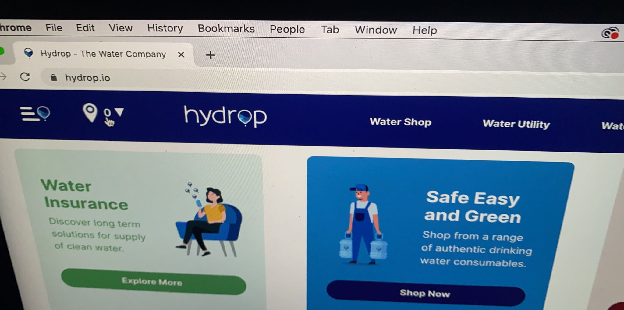
So we built for that. We brought over a hundred gated communities into rainwater harvesting, properly instrumented, properly maintained. And within a couple of seasons we had a problem I never expected to have during a drought.
We had too much water.
Harvested, clean enough, sitting in communities that could not possibly use it all. So we found it a home. We partnered with industrial and corporate sites that needed large volumes for centralised cooling, and we moved the surplus to them. Communities earned from water that used to run into a storm drain. Industry got supply that did not draw down the municipal system. It worked. It was, in miniature, the exact thing I had wanted to exist while standing in that queue.
What ended it was not the technology. It was not the market either.
The water mafia in Indian cities is not a metaphor. Tanker operations, borewell interests, the informal networks that decide who gets water and at what price. These are real businesses with real revenue, and our model was a direct subtraction from that revenue. Every community we moved into surplus was a customer they lost. We clashed with them, and then we clashed often. Then came the fake cases. Then came the threats, to us and to people around us.
We made a decision I still believe was correct and still do not enjoy. We walked away. We could have won. The price of winning would have been paid by people who never signed up for the fight.
One thing came out of Hydrop that has never left me. By the end of 2022 I was certain that anything worth my remaining working life would be about coordination failure. I had watched abundance and desperation share a street on the same day. I had learned that the barrier between them is almost never physical.
Chikkamagaluru, and the ledger
Atlantis was the second company. It was where I stopped treating trust as a soft thing.
The premise was simple to say and difficult to do. Take a region. Surface its vitals: water, electricity, education, the metrics that decide whether life there is getting better or worse. Score, plainly, where it falls short. Generate the concrete tasks that would move those numbers. Let the local community do the tasks.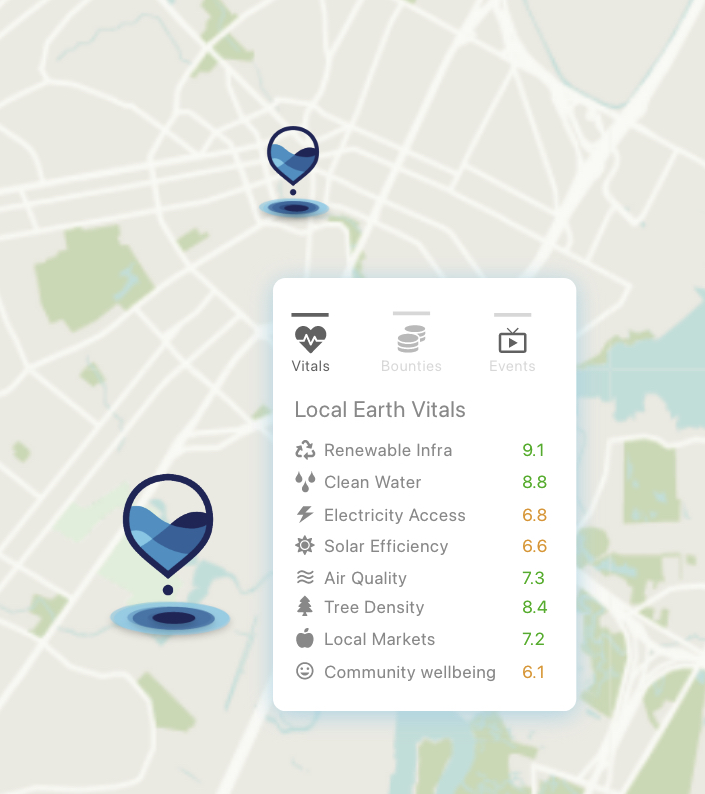 Let the local community verify the work was done. And when work is verified, the person who did it earns impact points, a durable record of what they contributed to the place they live.
Underneath it all sat a question about reciprocity. Communities used to hold together because contribution was remembered. If you helped, and later you were the one in trouble, the neighbourhood showed up. That memory has thinned nearly everywhere, and I have come to believe much of what we call social breakdown is exactly that. Contribution stopped being legible. So it stopped being repaid.
Mercy Corps Ventures funded us to test it. We went to Chikkamagaluru, rural Karnataka, and worked across more than five villages with thousands of people, building a peer-to-peer water network from the bottom up. Everyone in it was local. People signed on as water system taggers, mapping what existed. As samplers, testing quality across sources. As rainwater harvesters. As transporters. As savers and educators. Within weeks a small labour market existed where none had before.
Drinking water quality in that region improved dramatically. That is the outcome I am proudest of. It is not the reason the project got attention.
What drew attention, including from the Crypto Council for Innovation, which is not a sentence I ever expected to write about a village water project, was the ledger underneath. Every contribution. Every verification. Every point issued. Every rupee that changed hands. All of it written to a tamper-proof record that no participant could edit, ourselves included.
And then something happened that I consider the most important thing I have ever watched.
 People who had no reason to trust each other began trusting each other. Quickly. Not because they became better people over eighteen months, but because the cost of verifying a stranger's claim fell to almost nothing. You no longer had to know someone's family. You could see what they had done, see that it had been checked by people you did know, and know the record could not be rewritten later. Trust stopped being a relationship. It became a lookup.
Coordination requires collective sense-making. A shared taxonomy, a shared lexicon, an agreed definition of what counts as done. Sense-making alone gets you agreement. Provenance converts agreement into action: a record of who did what, that nobody can tamper with, that accumulates. Put those two things in one place and a group's capacity to coordinate compounds.
In Chikkamagaluru that meant a woman could have a tank cleaned by someone three villages away, on the strength of a record rather than an introduction. I learned that standing in fields, not in front of a whiteboard.
Dubai, and the grid that runs itself
I left India and moved to Dubai in 2026. One of my first serious meetings here was with the water ministry, about what grids should look like in twenty years. I said the thing I believe. Critical infrastructure has to become autonomous. Not automated in the sense of a few control loops and a dashboard. Autonomous. Sensors, actuators, agents, robots, drones, sensing and negotiating and reallocating continuously, at a speed no human operations team can join without becoming the bottleneck.
Humans do not vanish from that picture. They move up. They become the architects of the system, the ones deciding what it may do and what it must never do, rather than the ones manually approving the next valve.
I care about that conversation for a reason that is partly geographic and a little personal. India showed me coordination failure at its most human and most painful. The queue. The drought pricing. The mafia. Dubai showed me a state willing to imagine infrastructure that coordinates itself. Two ends of one line. I have stood at both, and it took me years to notice they were the same line.
But we are not there. Not close.
And the missing piece is not intelligence. Intelligence got cheap, and it keeps getting cheaper. The missing piece is that an autonomous system is a system full of parties who have never met, acting on each other's behalf, at speeds that make human verification impossible. A water agent has no relationships. It cannot call someone who knows someone. It has to answer three questions about every counterparty, instantly and provably. Who are you. What are you allowed to do. What have you actually done.
That is Chikkamagaluru's ledger, at planetary scale.
So that is what I am building now, at Kordn. The layer that lets businesses, and eventually the agents acting for them, establish identity, mandate and history well enough to coordinate at machine speed without anyone standing in the middle. We start with small businesses, because that is where coordination failure costs the most per person and attracts the least glamour, which is usually where the real problems live.
Eight years to see this about myself.
In every company I have built, the coordination layer was me. I was the person on the phone routing bottled water across seven hundred kilometres. I was the person standing between a hundred housing societies and an industrial cooling plant. I was the person holding the taxonomy in my head so that villages and funders and testers could all mean the same thing by the same word. I was the middleware. I did it by hand, it did not scale, and every time I stopped, everything stopped.
I am now trying to build the thing that means nobody has to do that by hand again.
If it works, the queue disappears. Water is already abundant. What returns to people is the human energy they currently spend overcoming coordination failure. That energy is the resource being wasted. Every engineer in that line lost hours of their life that week to a problem that was, in the most literal sense, solvable.
I still think about that line. Not with anger. Still with the shock.
It should not have been there.
It does not have to be.